ON TRANSLATING THE BIBLE
The purpose of this workshop is to encourage readers to attempt their own translation of a short biblical text and to promote through this experiment an awareness of what the task/art of translation, in this case Bible translation, involves. Knowledge of Hebrew, the source language of the most ancient books of the Bible, is not essential. It is hoped that four different English versions and some commentary will provide the enterprising translator-to-be with sufficient material to join in this literary venture. For readers of Hebrew, the source text 1) appears at the head of the English versions.
How select four versions among a countless number? The Bible has been translated, continues to be translated more than any other book in the world. (It is in itself a library rather than "a book": the word "Bible" derives from Greek biblia, meaning "books"). The Hebrew Bible being first and foremost a Jewish heritage, the first version quoted is the 1982 edition of The Jewish Publication Society of America 2). This is an update of former JPSA versions, the earliest of which appeared in 1917. There follows the 1962 edition of The Revised Standard Version 3) from The Oxford Annotated Bible. The history of The Standard Version goes back to the sixteenth century, to those early English Bibles which pioneering translators like Tyndale paid for with their lives. In contrast, the next is The New English Bible 4) in "current" English, whose "Old Testament" books were first published in 1970. In contrast again, last is my own version, At the start… Genesis made new, 1992. 93. 5) which is discussed in some detail below.
After this brief introduction, what better place to begin than at the beginning…? Here then are the opening verses of the first book of the Bible (hereafter referred to as Genesis). The source text in Hebrew is followed by the four translations mentioned 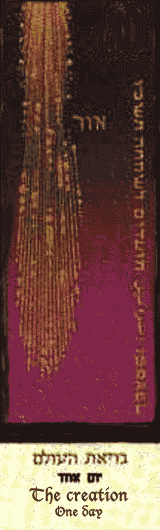 | 1) THE HEBREW TEXT
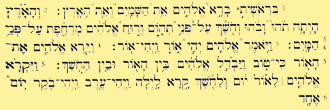
|  | 2) THE TORAH, THE FIVE BOOKS OF MOSES
The Jewish Publication Society of America, 1982.
1When God began to create the heaven and the earth – 2 the earth being unformed and void, with darkness over the surface of the deep and a wind from God sweeping over the water – 3 God said, "Let there be light"; and there was light. 4 God saw that the light was good, and God separated the light from the darkness. 5 God called the light Day, and the darkness he called Night. And there was evening and there was morning, a first day. |  | 3) THE FIRST BOOK OF MOSES COMMONLY CALLED GENESIS
The Revised Standard Version, 1962.
1 In the beginning God created the heavens and the earth. 2 The earth was without form and void, and darkness was upon the face of the deep; and the spirit of God was moving over the face of the waters.
3 And God said, "Let there be light"; and there was light. 4 And God saw that the light was good; and God separated the light from the darkness. 5 God called the light Day, and the darkness he called Night. And there was evening and there was
morning, one day. |  | 4) GENESIS: The creation of the world
The New English Bible, 1970.
1 IN THE BEGINNING OF CREATION, when God made heaven and earth, 2 the earth was without form and void, with darkness over the face of the abyss, and a mighty wind that swept over the surface of the waters. 3 God said, "Let there be light", and there was light; 4 and God saw that the light was good, and he separated light from darkness. 5 He called the light day, and the darkness night. So evening came, and morning came, the first day. |  | 5) AT THE START… GENESIS MADE NEW
Mary Phil Korsak, 1992. 93
1 At the start Elohim created the skies and the earth
2 – the earth was tohu-bohu
darkness on the face of the deep
and the breath of Elohim
hovering on the face of the waters –
3 Elohim said
Let light be
Light was
4 Elohim saw the light How good
Elohim separated the light from the darkness
5 Elohim called to the light "Day"
To the darkness he called "Night"
It was evening, it was morning
One day | COMMENTARY
It is hoped that what follows may stimulate the potential reader/translator, whether it is welcomed as illuminating or rejected as irritating. The commentary includes first an evocation of the salient characteristics of the language of Genesis, then a brief description of my approach to Bible translation and finally a detailed analysis of At the start… 1, 1-5.
THE LANGUAGE OF GENESIS
The Hebrew language is an old language. Biblical literature goes back to the period extending from the 12th century to the 2nd century BCE (Before Christian Era). Yet, poetically speaking, it may be described as a young language. It is as though the first human beings awoke to life and spoke… Hebrew. It is a young language because it has not outgrown its roots: a distinct tri-consonantal root is discernible in every word. No need here for etymological dictionaries! Hebrew vocabulary falls naturally into paronymical groups of interrelated verbs, nouns and adjectives. To illustrate what is meant by paronymical, here is a very simple example in English: in the phrase "sing a song" the verb "sing" and the noun "song" are paronyms. Genesis exploits the potential of Hebrew paronyms to underscore meaning.
It should be remembered at this point that the Bible texts we know go back to an oral tradition. They have survived thanks to memorisation and the handing down by word of mouth from one generation to the next. (In a small way the process may be compared to the English tradition of nursery and skipping rhymes). In this oral tradition, the number of interrelated words is increased by the frequent use of sound links, otherwise known as assonance or "folk etymology". These sound links lend themselves to complex forms of wordplay and punning, which are not gratuitous. They serve to guide the listener's understanding. Wordplay is particularly significant in so-called naming verses, where the attribution of a new name is justified by an explanation based on assonance.
Yet another characteristic of the language of Genesis is the use of key words: in a given passage or story a particular word occurs several times. A key word helps memorisation . It also directs the listener's attention to what is important.
Besides wordplay and key words, the oral tradition delights in repetitions. Individual words are repeated. So are entire phrases and sentences. Sometimes there are slight but significant variations on a recurring sentence. The listening ear responds to the repetition of the familiar and is alert to deviations, which act as clues for the understanding. (Something comparable occurs in English fairy tales and in popular forms of legend and fable). When repetitions and variants are built into the rhythmic structures of spoken language, their impact is enhanced.
In conclusion, it can be said today that the more deeply biblical scholars investigate the verbal patterns created by etymologies, assonance and repetition, the more ready they are to compare a text such as Genesis to a richly worked tapestry or a piece of Bach music. Like colourful, interwoven threads or the musical notes in a work of genius, the spoken words of the Bible continue to refresh and inspire with their beauty and vitality.
MY APPROACH TO BIBLE TRANSLATION
My purpose in re-translating Genesis is to capture the formal aspects of the text described above. Form and content are inseparable: how something is said can be as important for meaning as the words that are used to say it. For example, ironically expressed words have exactly the opposite meaning to the same words expressed without irony. Translating form requires a particular strategy. Besides asking "What does this mean?", the translator asks further questions, such as "Can a word repeated in the source text be repeated in the target text also?" "What light is shed on the meaning of a word by referring to all its contexts?" "To what extent is it possible to translate assonance, wordplay and punning?" "How best convey to the listener/reader the rhythms of the spoken text?".
The translation strategy I have adopted is new and yet not so. It is in line with the pioneering work of Martin Buber and Hans Rosenzweig, who translated the Hebrew Bible into German between the nineteen twenties and the nineteen sixties. A further debt must, of course, be acknowledged to other predecessors, to scholars and translators, to the studies they have carried out and to the practical tools they have forged, including lexicons, concordances, thesauruses. The English language itself is indebted to Bible translators. Nevertheless, at the end of the day, the literary translator, conscious of her artistic role, works alone, resorting to her own head and heart to make those individual choices that are part of creative reading and re-writing.
ANALYSIS OF AT THE START… 1,1-5
The translation, At the start… Genesis made new, intends to convey the flavour of a Hebrew text that is historically, geographically and culturally distant from us. To achieve this, a great deal of lexicographical research in both the Hebrew and the English languages has been carried out. To communicate distance and difference, the translation follows Hebrew word order as closely as possible. It adopts a free verse layout that reflects the spoken rhythms of the source text. Punctuation is minimal: there is none to speak of in the Hebrew. As to the target language, the medium chosen is correct, modern but not current English. Preference is given to words with Germanic roots, which are felt to be closer to popular speech than Latin and Greek borrowings. English archaisms are avoided, as are biblical heirlooms such as "beget". Everyday words are preferred to those consecrated by religious usage, for example, "sky/skies" rather than "heaven/s" (Gen 1,1).
The words "At the start…" translate the initial phrase of Genesis. This phrase is made up of two words, a preposition, "in", "among", "at"… and a word meaning "beginning", "principle", which shares a common root with the word for "head", (suggestive of "heading"?). According to rabbinical tradition, this one locution has been interpreted in seven hundred different ways. Let the would-be translator not be discouraged! At the start… is also the title of the translation. In the ancient near East, texts are known by their opening words. The familiar name Genesis is inherited from Greek translations.
Elohim is a Hebrew name for the divinity. It has a plural ending. It is translated sometimes as "gods" but more usually as "God". When speaking of themselves/himself, Elohim uses the plural "We" (Gen 1,26) as well as the singular "I" (1,29). Rare are the translators who acknowledge that Elohim, meaning the Hebrew God, is sometimes, if rarely, followed by a plural verb. This is the case in verses 20,13; 31,53 and 35,7. Habitually, however, the accompanying verb is in the masculine singular. In brief, the name Elohim suggests both a plural and a singular being. This may well surprise the contemporary English mind which thinks in terms of "either/or" (either plural or singular). Hebrew concepts are not so clearly defined: they are open to "both/and" categories. Finally, Elohim is not the personal name of the Hebrew God. God's personal name is written with four unspoken consonants, known as the tetragrammaton. These four consonants are represented in At the start… by YHWH.
earth Two translations are possible: "earth" and "land". A big discussion could be launched here... What would your choice be?
tohu-bohu The expression is one of very few that English has inherited from Hebrew. Its original meaning is uncertain.
breath The Hebrew word means" breath", "wind", "spirit". The translator does not reject the rich variety of meanings but, given the limits imposed by the target language, chooses to privilege one of them. The word for "breath", "wind", "spirit" is feminine in Hebrew. In Greek "spirit" is a neuter noun, in Latin it is masculine. And in English? Is the Holy Spirit, or Ghost, conceived of as masculine or without gender? Why not a feminine image, as suggested by the source text?
hovering "Fluttering", "hovering", "brooding": the feminine participle evokes the presence of a (mother?) bird.
face When referring to nature, Hebrew uses anthropomorphic terminology, as does English in some cases, e.g. the "foot" of the mountain, the "head" of the stream, the "arm" of the river.
Let light be Light was This is one of the most fascinating sentences in the Hebrew Bible. First, a general observation: Hebrew, unlike English, has no tense system. The two verbal categories, "imperfect" and "perfect", refer to what is yet to be (Let light be) and to what already is (Light was).
In the Hebrew text, the verb in Light was is subject to a grammatical inversion: the form of the verb is "imperfect"; the meaning of the verb is "perfect". The two parts of the Hebrew sentence are thus identical in form and different in meaning. A literal rendering would be something like this: Light be and Light be, where the first Light be denotes a command, the second Light be denotes a reality. The perfect language, whereby words correspond exactly to real objects? Even call them into being? Fortunately we do not all speak it!
In At the start… a new line in the free verse form often indicates the omission of the Hebrew co-ordinating conjunction "and", which commonly links Hebrew sentences and main clauses. Five English words translate five Hebrew words here, thus preserving the succinctness of the source text.
It was evening, it was morning The Hebrew day begins with the evening, in contrast to ours, which starts with the morning.
One day The number is cardinal, where the English reader expects an ordinal, "first".
Much more could be said about this short passage. Maybe this is enough to begin with…
Quoted from The Art of Literary Translation, British Council Literary Translation Exhibition: www.literarytranslation.com | |